Showing posts with label fairy. Show all posts
Showing posts with label fairy. Show all posts
Wednesday, March 24, 2010
The Fairy Origin of Abracadabra
Our article tracing the magic word abracadabra back to fairy origins is now available for free reading over at Witches & Pagans.


Sunday, May 17, 2009
Phantasmagoriamanacalectichon
Its first half referring to dreamlike imagery, this mouthful of a nonsense word is pronounced three times, in a clear voice, by a fairy in Edward H. Knatchbull-Hugessen’s Tales at Tea-Time (1872). The word transforms a misshapen hag into a sylph.
Wednesday, April 8, 2009
Rim-ram-rom-rum-rurifal-runcifer
This sing-song magic word of fairy lore echoes the tradition of ritually-chanted angelic names. The word is meant to be said three times while one lies flat on the ground. For those who are kind to animals but uncertain of the syllables, a long chain of glowworms will spell out this word as if “it were in gold letters upon the earth.” The effect of the word is a revelation of glamour—the unveiling of an enchanted woodland. As Edward H. Knatchbull-Hugessen describes it Tales at Tea-Time (1872),
The word had scarcely passed his lips for the third time before an occurrence took place which filled him with astonishment. A veil seemed to have been suddenly withdrawn from his face, and the whole scene before him had marvelously changed. Immediately before his eyes, within a few yards of the spot where he had lain down, appeared a forest, full of magnificent trees spreading out their branches towards the skies, heavy with luxuriant foliage. . . . Amid their branches a myriad birds poured forth the sweetest and most entrancing melody.
Tuesday, March 10, 2009
Glamour
Glamour refers to an almost hallucinatory fascination. It's a glittering, bewitching charm that beguiles in a thrilling way. How? By conjuring an "illusion of the eye which makes it see things other than they are." Put another way, glamour adds a sparkle of delight or wonder, with no apparent provocation in the beheld objects.
The "necromantic word" glamour grants "the mysterious gift of second sight . . . like the sudden turning on of a factitious light, just as in a theater the effects they call 'transformation' are accomplished by a changing of lights. In glamour the facts remain the same, your appreciation of the facts remains the same; but the significance is entirely changed." The beholder's entire natural world "crystallizes anew" around the glamorous object. "Nothing is quite familiar, all is invested with divine novelty, while . . . the 'spell' lasts. . . . Whether we should say of these momentary special intimations that the veil of enchantment has been thrown over the scene, or that the veil of dull accustomedness has been lifted, may always remain a debatable question. The so-called 'common-sense' view will adhere to the idea of illusion; the idealist, the poet, the artist, may well insist that thus should we always see objects if we saw them clearly and in toto; and I would hazard the theory that it is the perception, more or less perfect, of the subtle super-qualities of all objects of sense which keeps the poet in a divine emulation, tremulous between hope and despair, to make the rest of the world see what he himself quite habitually sees and hears. Whatever thus piques and holds the inner fantastic eye or ear, investing sight and sound with an enhanced wealth of significance to the soul, we may call glamour" (Edith M. Thomas, "Glamour," The Century Magazine, Vol. LI, No. 2, Dec. 1895).
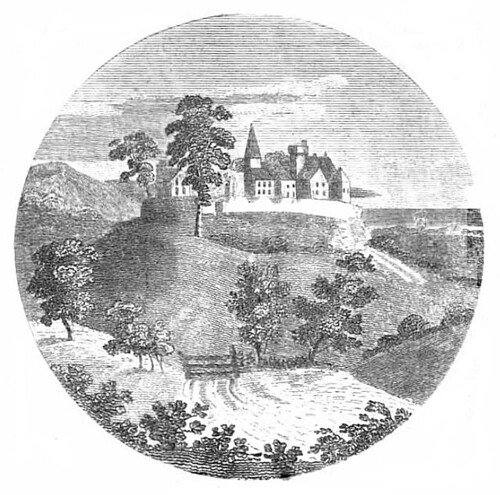
[Don't miss Futility Closet's eye-witness account of a fairy castle in Ireland.]
The "necromantic word" glamour grants "the mysterious gift of second sight . . . like the sudden turning on of a factitious light, just as in a theater the effects they call 'transformation' are accomplished by a changing of lights. In glamour the facts remain the same, your appreciation of the facts remains the same; but the significance is entirely changed." The beholder's entire natural world "crystallizes anew" around the glamorous object. "Nothing is quite familiar, all is invested with divine novelty, while . . . the 'spell' lasts. . . . Whether we should say of these momentary special intimations that the veil of enchantment has been thrown over the scene, or that the veil of dull accustomedness has been lifted, may always remain a debatable question. The so-called 'common-sense' view will adhere to the idea of illusion; the idealist, the poet, the artist, may well insist that thus should we always see objects if we saw them clearly and in toto; and I would hazard the theory that it is the perception, more or less perfect, of the subtle super-qualities of all objects of sense which keeps the poet in a divine emulation, tremulous between hope and despair, to make the rest of the world see what he himself quite habitually sees and hears. Whatever thus piques and holds the inner fantastic eye or ear, investing sight and sound with an enhanced wealth of significance to the soul, we may call glamour" (Edith M. Thomas, "Glamour," The Century Magazine, Vol. LI, No. 2, Dec. 1895).
[Don't miss Futility Closet's eye-witness account of a fairy castle in Ireland.]
Friday, July 11, 2008
Fairy
“The word ‘fairy’ is a very modern word as used in the sense of spirit. The original meaning of the word was magic, supernatural power, and the old English writers used it in this sense. . . . The word used to be spelled ‘faerie’; and the term ‘faerie land’ originally meant ‘land of magic.’ Much later the term was applied to a supernatural being or person, for which the real English word was El, or Elf.”
—Lafcadio Hearn, Life and Literature (1917)
—Lafcadio Hearn, Life and Literature (1917)
Subscribe to:
Posts (Atom)